Homepage English |
 Homepage deutsch |
Articles and reports |
 Unsere Filme auf YouTube (Übersicht) Our movies on YouTube (abstract) |
|
|
Drosera hartmeyerorum,
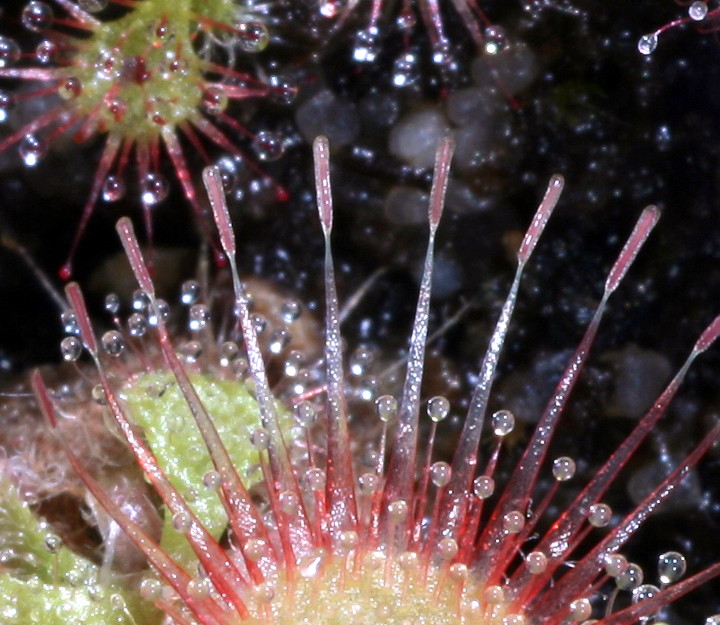
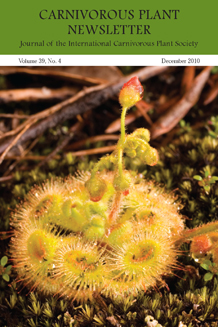
der Sonnentau mit Restlicht-Verstärkern Zusammenfassung: Die einjährige nordaustralische Drosera hartmeyerorum wurde von Irmgard und Siegfried R. H. Hartmeyer 1995 nahe Kununurra gefunden, gefilmt und aufgrund ihrer einzigartigen Emergenzen als neue Art eingeschätzt. Überraschenderweise war die Pflanze bereits seit Mitte der 1990er Jahre durch Samenverkauf in Australien weltweit in Karnivorensammlungen als Drosera indica "red" verbreitet. Im Jahr 2001 folgte die wissenschaftliche Beschreibung und Benennung als eigenständige Art durch Dr. Jan Schlauer im Carnivorous Plant Newsletter. Das besondere Merkmal sind gelbes Licht reflektierende Emergenzen an der Blattbasis und an den Brakteen der Blütenstängel. Eine Untersuchung der Struktur, die wir in Zusammenarbeit mit Prof. Dr. Stephen Williams (USA) durchführten, zeigte eindeutig, dass es sich dabei um wabenförmige glasklare hohle Riesenzellen handelt, die das einfallende Sonnenlicht auf ein intensiv gelbes, massives Zentrum leiten, von denen helles gelbes Licht reflektiert wird. Drosera hartmeyerorum,
the sundew with residual light amplifiers Abstract: The annual Northern Australian Drosera hartmeyerorum was found, filmed and evaluated to be a new species in 1995 by Irmgard and Siegfried Hartmeyer near Kununurra. Surprisingly the plant was spread world-wide in several CP-collections by selling the seeds from Australia labelled as Drosera indica "red". The scientific description took place in 2001 in Carnivorous Plant Newsletter by Dr. Jan Schlauer. Unique are its yellow light reflecting emergences at the leaf base and bracts on the pedicel. An examination of the structure, executed together with Prof. Dr. Stephen Williams (USA), brought to light that the tentacle-heads consist of several honeycomb glas-clear hollow giant cells, which focus the sunlight to a massiv yellow center, from which it is reflected as bright yellow light which is very attractive to insects. |
||||||||
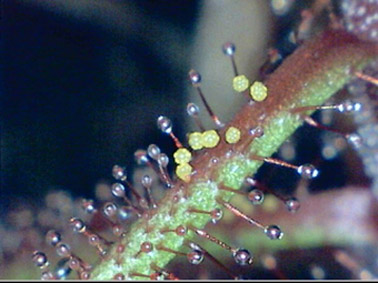
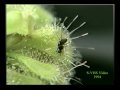
  Hartmeyers Sonnentau unter Laserbeschuss Hartmeyers Sonnentau unter LaserbeschussLaser fire on Drosera hartmeyerorum  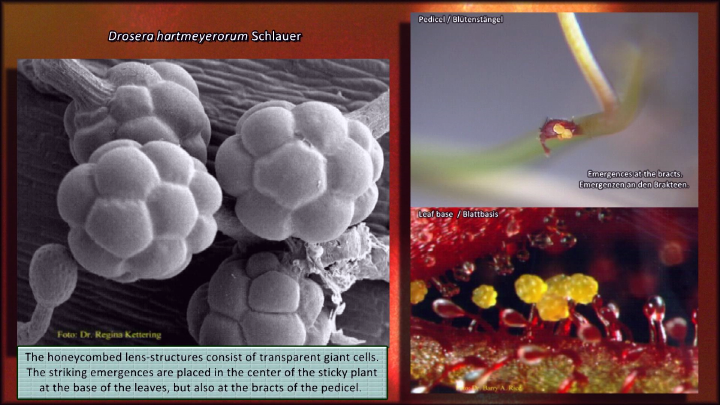 Unsere Experimente zeigen, dass die gelben Emergenzen von Drosera hartmeyerorum
wie ein Restlichtverstärker funktionieren, vergleichbar den Augen
von Krokodilen und Katzen, die nachts mit einer Lampe angeleuchtet
werden.
ACHTUNG: Laserstrahlen sind gefährlich. Unbedingt die Augen schützen, wenn solche Tests durchgeführt werden, besonders wenn der Laser durch eine Lupe betrachtet wird. Our experiments suggest that the yellow emergences of Drosera hartmeyerorum act like a residual light amplifier, comparable to the eyes of crocodiles or cats when illuminated with a torch at night. The film provides our experiments with different light sources like halogen and red laser. CAUTION: Laser beams are dangerous. Protect your eyes when you conduct such tests, especially when you observe the laser through a magnifier. |
Die einjährigen Sonnentau zeichnen sich durch die raffiniertesten Fangmethoden aus, um genügend Protein für einen vollständigen Lebenszyklus in nur einer Saison einzufangen. Nie zuvor gezeigte Aufnahmen. Anmerkung: Dieser Film gewann einen 2. Preis im ChloroFilms Plant Biology Contest 2010. The Wettbewerb wird von der Pennsylvania State University organisiert und von YouTube unterstützt.
The anual Drosera species develop the most sophisticated trapping mechanisms in the genus, to catch enough protein for a complete life-cycle within a single season. Remark: This footage awarded a 2nd price in the ChloroFilms Plant Biology Contest in 2010. The contest is organised by the Pennsylvania State University and supported by YouTube. |
||||||||
|
|
|
||||||||
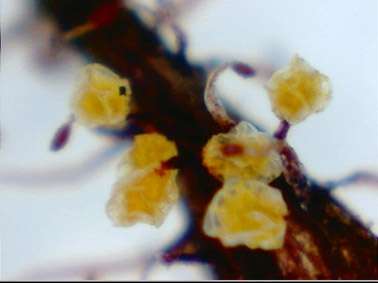
After some days drying the translucent outer layer and the massive yellow centre become good visible. |
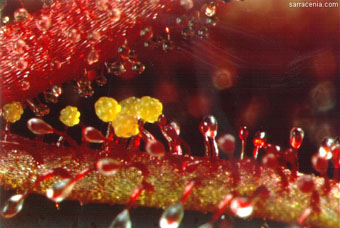
Foto Dr. Barry Rice (USA) (www.sarracenia.com) |
||||||||
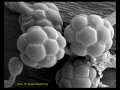
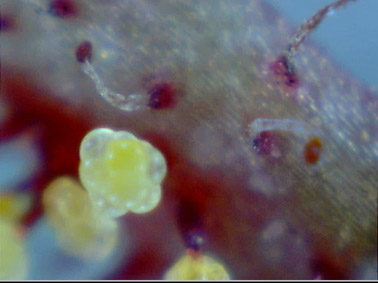
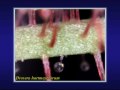
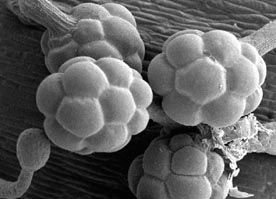 Die Raster
Elektronen Mikroskop (REM) Bilder oben und rechts wurden von Dr. Regina Kettering,
im Rahmen unseres gemeinsamen Projekts mit Prof. Dr. Stephen Williams am
Lebanon Valley College in den USA gemacht. Die Linsenstruktur besteht aus Riesenzellen
und ist offensichtlich hohl, wie die kollabierte Zelle auf dem Bild rechts zeigt. Deren Transparenz
ist bei dieser Technik nicht sichtbar, da die Oberfläche der erst von uns mit Glutaraldehyd
präparierten Blätter für die REM-Untersuchung mit Metallatomen bedampft wurde.
|
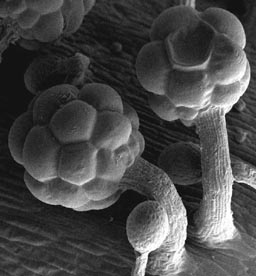
These pictures (above and left) are made with a Scanning Electron Microscope (SEM) by Dr. Regina Kettering, during
our common project with Prof. Dr. Stephen Williams at the Lebanon Valley College,
USA. The honeycomb lens-structure consists of giant cells and is clearly hollow,
as the collapsed cell on the photo shows. Their transparancy is invisible
with this technique, because the surface of the specimen, which had been prepared
by us with glutaradehyde before, was additionally covered with metal atoms for the SEM examination.
|
||||||||
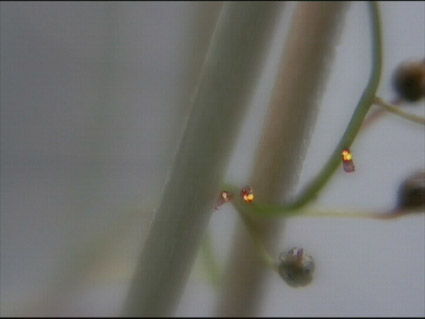
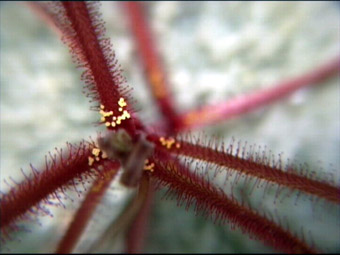
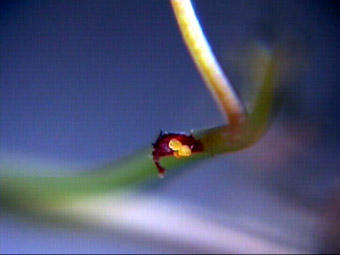
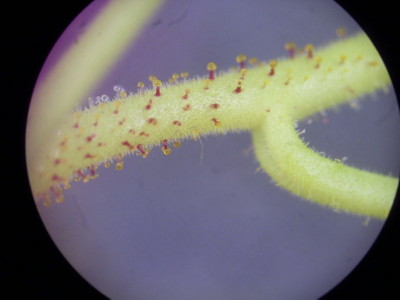
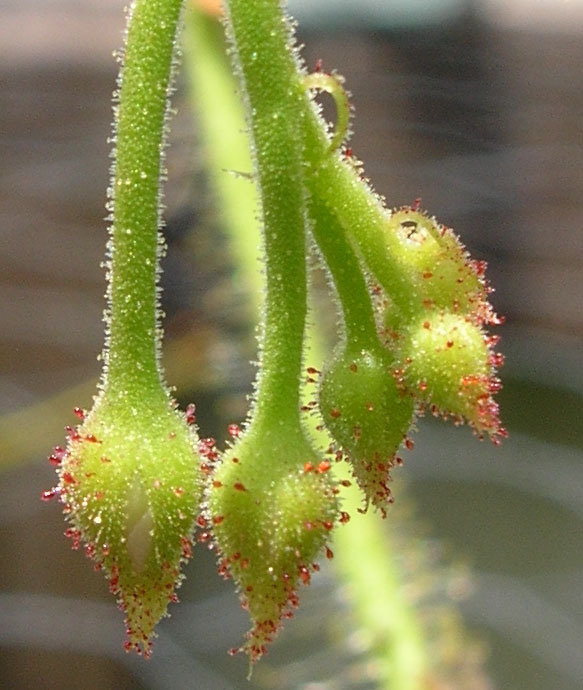
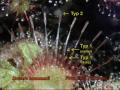
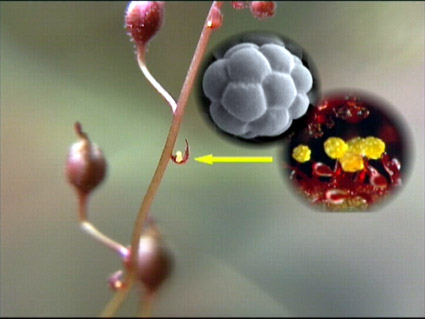 Die Emergenzen wachsen ebenfalls an der Basis der Brakteen auf dem aufrecht wachsenden Blütenstängel, wo sie von oben gesehen bei Lichteinstrahlung eine regelrechte Lichterkette (Landescheinwerfer) bilden (Bild unten). |
|
||||||||
 |
 |
||||||||
| Die Sonnentau der Sektion Arachnopus
bilden zu keinem Zeitpunkt Schnelltentakel, weder als Sämling noch
ausgewachsen. Offensichtlich haben sich diese aufrecht wachsenden
großwüchsigen Arten nicht darauf spezialisiert Beute
besonders effektiv festzuhalten, wie z.B. D. burmannii oder D. sessilifolia,
sonder optimierten im Laufe der Evolution ihre Methoden zur Anlockung
von Beute, durch die Umwandlung bestimmter Tentakel, um wie D. hartmeyerorum
für Insekten attraktives gelbes Licht zu reflektieren. Auch
die von Südafrika über Asien bis Australien verbreiteten Pflanzen der Sektion Arachnopus
bilden recht unterschiedliche Emergenzen. The sundews of section Arachnopus never develop snap-tentacles, neither as seedling nor as adult plant. These large upright growing species did not specialize to fix prey effectively like D. burmannii or D. sessilifolia, but optimized their methods to attract prey by changing the morphology of particular tentacles, for example to reflect attractive yellow light for insects like D. hartmeyerorum. All plants in section Arachnopus, which occur widespread from South Africa over Asia down to Australia, show different emergences.
|
|||||||||
 Email
Email